Katja Collects: Gibson Les Paul Guitars
Unique Pieces, Expert Insights
Few musical instruments have achieved the cultural status of the Gibson Les Paul guitar. Introduced in the early years of rock and roll, the model became synonymous with generations of influential musicians. Think blues and classic rock pioneers as well as alternative and contemporary artists.
More than tools of performance, certain Les Paul guitars have become artifacts of popular culture. They carry the stories of the musicians who played them and the music they helped create. For collectors of these guitars, a Les Paul’s appeal often extends well beyond its craftsmanship, carrying the history of the musicians and music connected to it. In September 2026, one such example, a black 1980 Gibson Les Paul Standard owned by The Smiths guitarist Johnny Marr, sold at Christie’s London for approximately $48,000, illustrating how personal history can transform an instrument into a collectible.
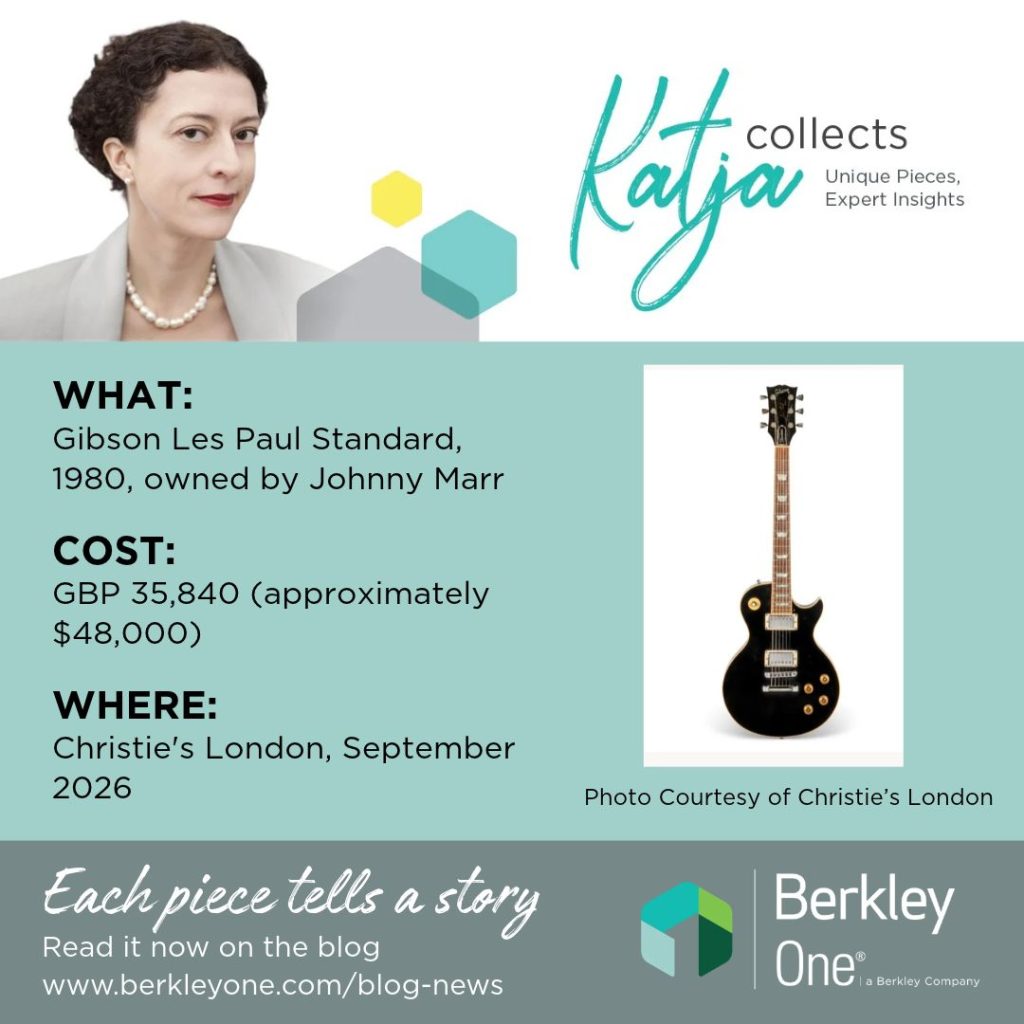
WHAT:
Gibson Les Paul Standard, 1980, owned by Johnny Marr
COST:
GBP 35,840 (approximately $48,000)
WHERE:
Christie’s London, September 2026
________________________________________
Hear It:
What do Johnny Marr, Eric Clapton, Nancy Wilson, and Sister Rosetta Tharpe have in common? These musicians of varying musical styles all owned and played a Gibson Les Paul electric guitar. And to the benefit of music buffs, many musicians have sold some of their beloved string instruments at auction. Orville Gibson changed the music industry forever in 1894 when he constructed a guitar with a carved top construction borrowed from violin making rather than flat top cabinetry. That early emphasis on tone, structure, and prestige laid the foundation for what would become one of the most valuable instrument markets in the world. The Kalamazoo, the Michigan-based Gibson guitar company, became known for its well-crafted acoustic and archtop guitars and was a top choice for musicians playing folk, bluegrass, country and pop.
However, the electric guitar ushered in rock and roll, and Gibson played a key role in disseminating that sound in the 1950’s. The Fender Broadcaster was the first commercially available electric guitar, and Gibson introduced its new electric guitar in New York City in 1952.
The heritage brand had brought in the musician and innovator Lester Paul to collaborate on a new electric model, and his namesake creation— the “Les Paul”— became a staple of pioneering rock musicians in the 50’s and 60’s. Iterations of the Les Paul were made with varying materials, colors, and slight design alterations including: The Goldtop, The Standard, and Custom models.
Yet between 1958 and 1960, the company produced what are now considered the most coveted electric guitars ever made: the sunburst Les Paul Standards. Fewer than 1,700 of these signature, cherry-red sunburst finish Les Paul guitars were produced, and this scarcity drives the marketplace.
Condition, rarity, artist association, and cultural relevance also drive the record prices for these electrical guitars. Many iconic 20th century rock stars owned and played these guitars, and their influence elevated these instruments from tools to cultural icons.
Collect It:
The Smith’s guitarist, Johnny Marr, shared that a Les Paul was the first guitar he bought because his musical hero, Marc Bolan, had played one. That solid-body, black Gibson Les Paul Standard from 1980 sold for GBP 35,840 (about $48,000). That guitar was one of many that sold in a single owner guitar sale at Christie’s London in September 2026.
Each lot was accompanied by Marr’s personal history with that guitar and which songs it inspired, albums with recordings of his guitar playing, and tours where he used the instrument.
That personal connection for the musician – an iconic guitarist for a beloved Gen X alternative band— pushed most of the guitars sold at the auction to significantly above their pre-sale estimates, netting close to $5 million total.1
Artist ownership dramatically transforms value, and auction history makes this unmistakably clear. A Gibson Les Paul played by Guns N’ Roses guitarist Slash during their Not in This Lifetime tour sold for just over $300,000 in April 2026. On the higher end of record prices, Christie’s sold Jeff Beck’s 1954 “Oxblood” Gibson Les Paul for approximately $1.3 million, setting a world auction record for a Gibson Les Paul. Similarly, Eric Clapton’s 1964 Gibson SG, painted by the Dutch collective The Fool and used during his Cream years, sold at Julien’s Auctions for $1.27 million. Alas, an original 1953 Les Paul Sunburst Johnny Marr-owned guitar did not make it into his sale as he had gifted it to his friend, Noel Gallagher (Oasis), years earlier. It may appear at an auction for future generations.2
Clearly, contemporary artist provenance, when paired with documentation and visibility, fuel prices for these guitars that sit at the intersection of American craftsmanship, popular music, and today’s global collectibles marketplace.
Care for It:
Electric guitars do not require as strict climate controls as acoustic guitars, as they have solid bodies and are less sensitive to environmental shifts. However, maintaining stable humidity levels of 45-55% is ideal, and the guitar should be stored safely on a stand or inside a hard case. Also, the hardware and electronics of a Les Paul require more attention and need to be maintained. This includes the occasional cleaning of input jackets, pickup selectors, and volume/tone knobs.
Basic maintenance also includes regular string changes, fretboard conditioning (lemon oil on exposed wood), and a soft wipe-down after playing to remove sweat and skin oils.
–
About Berkley One
Berkley One is an insurance provider for modern, sophisticated individuals and families. We’re redefining insurance with technology, innovation, expertise and the backing of Berkley, one of the nation’s premier insurance providers. Offering customized options for homes, automobiles, fine art, collectibles, liability, recreational marine and collector vehicles, we give clients the confidence to move forward and live their adventure.