Katja Collects: The Declaration of Independence Printings
Unique Pieces, Expert Insights
Sometimes the paper carries as much weight as its words. That could be said for the first printings of our nation’s most precious documents. Slightly irregular, densely inked, and made to travel, the first newspaper printings of the Declaration of Independence capture a moment when ideas still moved at the speed of a horse. The Boston Athenaeum’s copy of the July 18, 1776 New-England Chronicle brings that moment into sharp focus. Produced just weeks after the Continental Congress ratified the text, the printing reflects a nation in the act of becoming. Seen nearly two and a half centuries later at the Athenaeum’s Imagined Nation exhibition, it feels both historic and strikingly immediate.
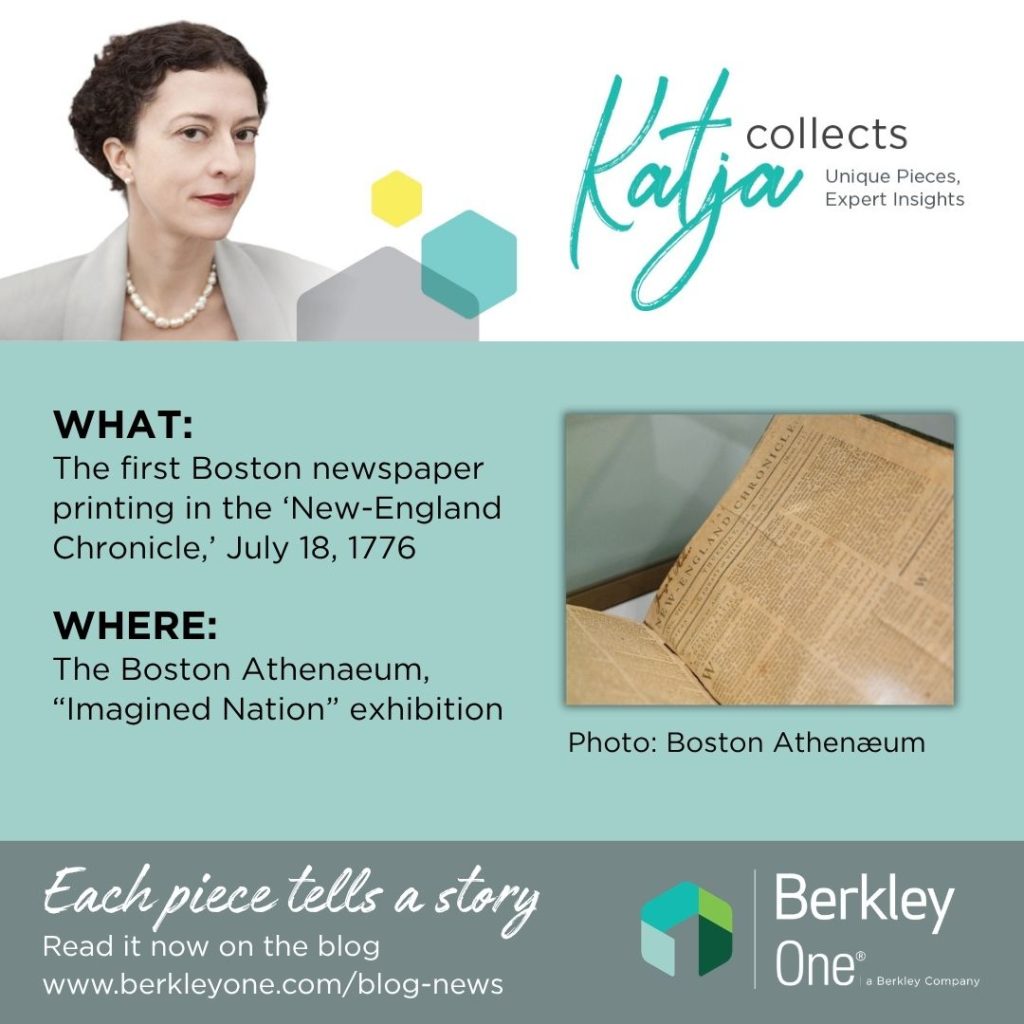
What:
The first Boston newspaper printing in the New-England Chronicle, July 18, 17761
Where:
The Boston Athenaeum, “Imagined Nation” exhibition
________________________________________
See It:
After the Constitutional Congress ratified the Declaration of Independence on the afternoon of July 4, 1776, John Dunlap, designated printer to the Congressional Congress, printed copies of the revolutionary treatise in the format of a broadside. These single sheets were then immediately dispatched with horse and rider to communicate the news to the states and the Continental Army. Within the next few weeks and months, reprints appeared up and down the east coast as news spread at town halls and through local newspapers. Now in 2026, numerous libraries and museums across the country are showcasing pivotal documents that highlight the founding of a nation in the year we celebrate America’s 250th, and the first printings of the intention of ceding from England are foundational.
The New England region has created “The Declarations Trail,” a consortium of institutions, among them The Boston Athenaeum, the Boston Public Library, the Leventhal Map Center, the Massachusetts Historical Society, and Harvard’s libraries to showcase more than a dozen different copies of the Declaration of Independence across a series of coordinated exhibitions. You can learn more about the trail here: https://declarationstrail.org/.
Collect It:
What exactly is a “version” of the Declaration of Independence? The term actually encompasses several bibliographical categories. The Dunlap Broadside (Philadelphia) — the version disseminated that evening of July 4th — was the first printed edition, and surviving examples are mostly in institutional collections. Yet communicating this important news required hundreds of “reprints.” Most of these documents took the form of newspaper prints like this one from the New-England Chronicle, books, or state broadsides. For the latter, imagine a poster with the Declaration printed on it, posted at a town hall or town square. Some early printings of newspaper and hybrid issues blur categories—appearing in print, or as large, single-sheet ‘extras’ that function like broadsides inserted into a newspaper. These hybrids underscore how fast printers mobilized to meet public demand in July 1776.
The market for early printings of the Declaration of Independence—especially 1776 broadsides—has entered a period of heightened visibility, record pricing, and renewed institutional (as well as private demand. Collectors and curators increasingly prize the wider ecosystem of contemporary regional broadsides (NH, MA, NY, MD, and others), newspaper impressions, later official state printings, and notable manuscript copies for their ability to connect national ideals to local histories. Recent sales between 2023 to this semi-quincentennial year illustrate intensifying competition, rising estimates, and an expanding set of collectors crossing over from art and rare books into Americana.
At auction, these kinds of rare historical documents would likely be sold during the “American Art Week,” a broad cocategory for selling American paintings, furniture, Americana, and historical objects that occurs twice a year. This past January 2026, Christie’s sold a Boston Gazette newspaper printing of the Declaration from July 22, 1776, for $241,300, and an Exeter, New Hampshire broadside for $5.6 million.
Key drivers of collectability today include scarcity, provenance to named collections, regional and print-shop attribution, condition, and of course the gravitational pull of round-number anniversaries that stimulate exhibitions and philanthropy. These dynamics, together with the document’s unmatched cultural symbolism, help explain why multiple distinct versions can command multimillion-dollar prices in the current market.
Care for It:
Rare manuscripts and paper documents should be protected from light, which is the primary source of fading and chemical breakdown. If it is displayed:
- Use UV-filtering glass or acrylic
- Limit light exposure to < 50 lux (typical museum standard for works on paper)
- Avoid direct sunlight entirely
When not on view, store any document or work on paper in archival quality housing such as an acid-free, lignin-free folder or box, buffered by archival paper.
Berkley One is an insurance provider for modern, sophisticated individuals and families. We’re redefining insurance with technology, innovation, expertise and the backing of Berkley, one of the nation’s premier insurance providers. Offering customized options for homes, automobiles, fine art, collectibles, liability, recreational marine and collector vehicles, we give clients the confidence to move forward and live their adventure.