Part 1: Western Art’s Market Momentum and Modern Relevance
Insights from Elizabeth Pisano of Winston Artory Group
Go West was the rallying cry of the 19th century, when the American government urged expansion to the coast opposite the founding colonies. While this westward momentum had mixed implications – the decimation of Indigenous habitats, forced labor to build railroads, and the perilous terrain that cost many lives— the new awareness and awe of the incredible natural wonders of the country was undisputed. A handful of artists captured the beauty and brutality of this time-period, and memorialized the real, ideal, and imagined.
The West has also been “re-won” in the marketplace, as auction activity and interest has surged this year, led by Visions of the West: The William I. Koch Collection. The two-part single owner in January 2026 set numerous artist records and reiterated the interest and passion for this unique genre.
Statistics from ARTdai also underscore the increased market volume and price points in the past year.
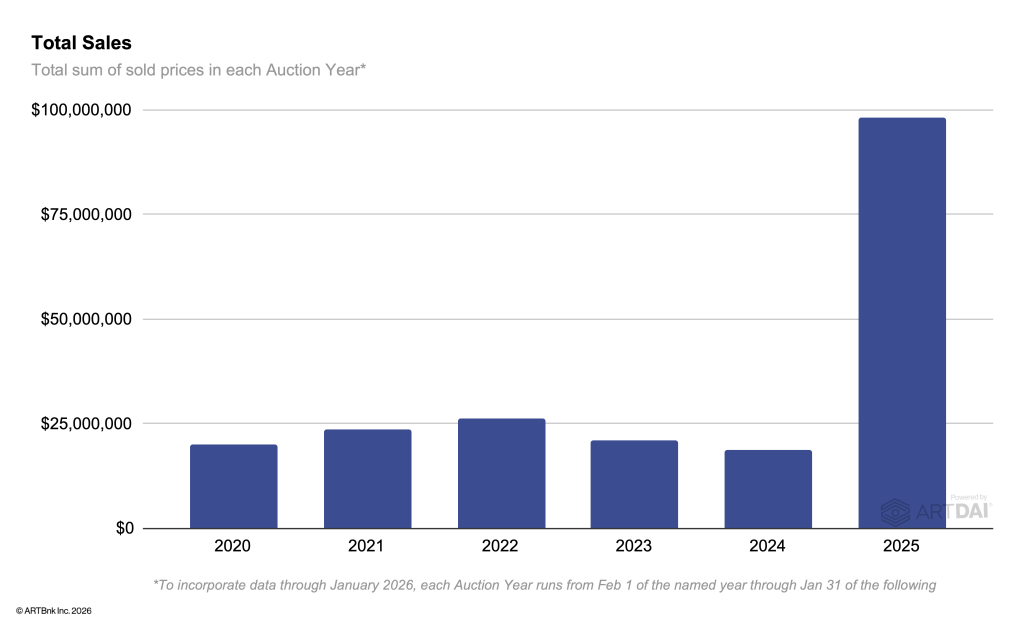
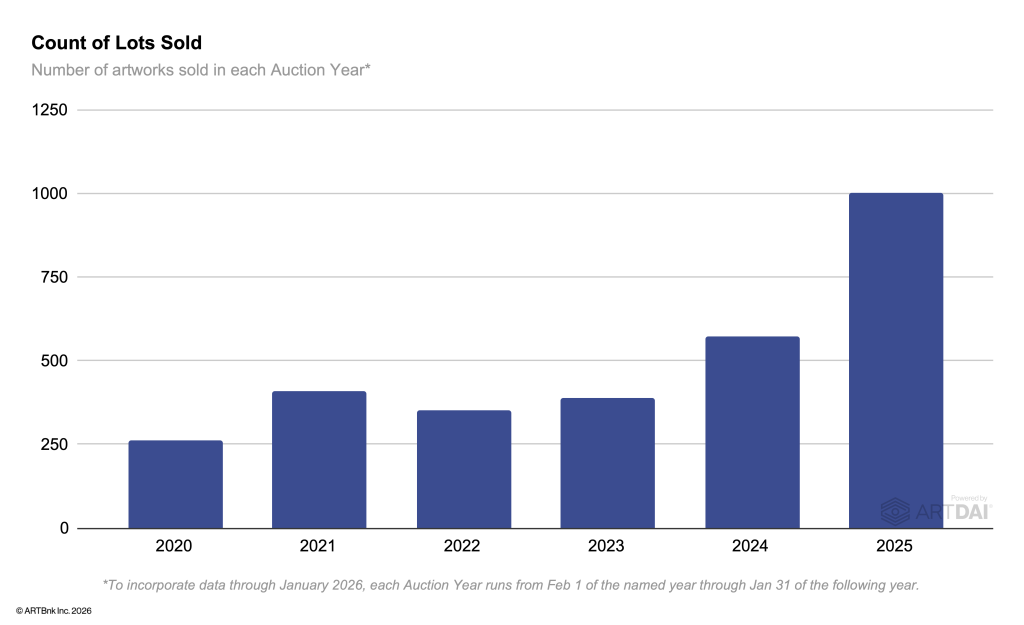
Western Art is a genre infused by the past, yet it somehow also remains relevant in the present—in the first of a two-part exploration, we look at its resurgence today. In the past decade there has been a surge in property purchased in the western mountain states – think Montana, Wyoming, Idaho, Utah and Colorado. As one generation moves there for retirement, another relishes weekend homes adjacent to ski slopes and open vistas.
Recent series like Yellowstone and Landman have underscored interest in the region and its tumultuous social, political, and environmental history. The landscape of the West continues to be a source of inspiration to artists today, and contemporary interpretations are on view at galleries, art fairs, and auction houses from Texas to Arizona, Idaho, and in-between. To get a better sense of the breadth and market renaissance of artwork inspired by the West, I spoke with Elizabeth Pisano, Senior Director and American Art Specialist at Winston Artory Group.
Katja: Let’s start with the basics. What exactly is “Western Art” and how does it fit into the history of American Art?
Elizabeth Pisano: I studied American paintings during graduate school, but we never talked about Western Art until I started working at an auction house and realized Western Art was sold within the American art category. So, American art as a genre or collecting category is actually quite diverse. I don’t think people really understand that it includes about 5 centuries and has numerous subgenres. Western art is one of them and begins around the early 19th century.
On a personal note, I grew up going to Wyoming, and my parents now live there, so I am also geographically close to locations memorialized by painters and collectors who have an affinity for this genre. Though of course these artists idealized their subject matter, it’s amazing to realize the places depicted by some of these artists actually look like that in real life. It’s an imagery that’s very close to my heart, and I think it’s like that for a lot of people.
Katja: If you collect Western Art, I assume you are on the younger end of the age demographic of the typical Western art collector?
Elizabeth Pisano: So, yes. It’s interesting you noted that the collector age is often post-60, because that’s very much a characteristic of the American art category overall, and that’s one of the main obstacles to the traditional category. There was this amazing collector base of people who were lifelong collectors of this type of material, and were so passionate about it, and they’re all just aging out.
We are experiencing a shift in which a generation of established collectors are passing on, and their collecting legacy is coming to the marketplace.
Katja: Yes, and that is certainly the context for the historic Koch sale at Christie’s this past January. It was the highest-value Western sale in history, making close to 70 million dollars while setting a few artist records along the way.
Elizabeth Pisano: Yes, this is one of those iconic collections that in its breadth and depth of material and collecting features the best of the best. I was at the historic Tuesday evening auction and let me tell you, the atmosphere was lively and there was enthusiastic, competitive bidding throughout the sale, clearly from both established collectors but also seemingly a lot of new people. Those new people are critical to the enduring success of the category. It’s pretty rare these days to see that level of competition in a predominantly American sale.
The auction featured two oils by Remington, both from his late period, that realized prices in excess of $10 million. This result speaks to their quality but also to their rarity, and collectors in this market show time and time again their willingness to compete for examples that they may not be able to track down again. Coming to the Call, which sold for just over $13 million, setting a new record for Remington’s work at auction, demonstrates the direction the artist’s work might have continued to take had he not died tragically at just 48 years old. It’s remarkably modern in its color and form, showing the artist moving away from straightforward narration towards an embrace of color, light, and atmosphere as subject matter in their own right.
An Argument with the Town Marshall, which now holds the record for the second highest price paid at auction for a Remington, is one of the artist’s rare nocturnes, one of only 70 he produced.
These works find Remington at the height of his powers — retaining his signature dynamic compositions and narrative strength while employing a far more restrained palette and reduced detail.
Katja: Of course, Frederic Remington (1861-1909) is so special because he is also adept at bronzes in addition to paintings! Can you discuss the marketplace for his bronze cowboy sculptures?
Elizabeth Pisano: Remington’s bronzes are consistently popular, but they can vary widely in quality and value. The most desirable and most valuable casts are those that were produced during Remington’s lifetime. These are also generally the rarest. His widow, Eva, authorized castings of certain models after his death that are also considered valuable. The specific foundry that produced the cast can also have an impact on value. Generally, you want to pay attention to the cast number and the “crispness” of the cast.
There are hundreds of unauthorized posthumous casts on the market. These examples are generally less detailed and lack the texture and depth of the authorized casts because they are made from other casts, not from the original model.
The Broncho Buster is definitely the most popular and recognizable of Remington’s bronzes, from the 19th century when it was made through today. Teddy Roosevelt’s Rough Riders gave him a cast in 1898, and another version has been displayed in the Oval Office of the White House almost continuously since the Jimmy Carter administration.
Katja: Yet the evening sale wasn’t White Glove (auction slang for a 100% lot sold sale). Let’s talk about the Albert Bierstadt painting, Mountain Lake that didn’t sell. Can you share your thoughts on that?
Elizabeth Pisano: Albert Bierstadt’s Mountain Lake failed to find a buyer at its pre-sale estimate of $2,000,000-$3,000,000 and it is interesting to note that it sold at auction previously in 2007 for $4,856,000. This period has always been recognized as the peak of the market for American Art and I think this result, or the comparison between the two, really speaks to that. The market is just way more selective now as collectors increasingly prioritize true quality. This is a lovely example, but it critically does not depict a single, identifiable location, which is important to Bierstadt collectors, particularly when considering a purchase at this type of price point.
Katja: Another unique characteristic of Remington, and his peer Charles Marion Russell, is that they both started as illustrators. This technical skill influenced their aesthetic, and it also means there is a lot of works on paper from these artists that expand the marketplace and availability of their work at more modest price points.
Elizabeth Pisano: Yes, actually many of the most prominent American artists of that era got their start as illustrators — Remington and Russell, but also Winslow Homer and many others. Working on commission for the major publications of the day taught these artists how to make an image as impactful as possible and instilled a desire to imbue a strong sense of narrative that I don’t think either Remington or Russell ever fully left behind. Both were also remarkably versatile across media — bronze, oil, watercolor. Russell’s watercolors in particular are highly prized; they’re often just as finished and dynamic as his oils.
Read on in Part 2, where we continue the conversation.
Image credit: Kay Walking Stick, “Sage Brush and Cholla”, 2025, exhibited at Hales Gallery
_
Katja Zigerlig is Vice President of Art, Wine + Collectibles Advisory at Berkley One (a Berkley Company).
Berkley One is an insurance provider for modern, sophisticated individuals and families. We’re redefining insurance with technology, innovation, expertise and the backing of Berkley, one of the nation’s premier insurance providers. Offering customized options for homes, automobiles, fine art, collectibles, liability, recreational marine and collector vehicles, we give clients the confidence to move forward and live their adventure.