Katja Collects: Meg Webster
Unique Pieces, Expert Insights
Despite the brisk temperatures and silver breath, deep winter has a way of sharpening our attention, making even the simplest materials feel vivid. Meg Webster’s Moss Bed, Twin does exactly that. A simple rectangle of dormant moss shaped like a standard bed becomes a gentle meeting point between Minimalist form and the living materials she’s spent decades exploring. Seen indoors, it feels both familiar and slightly uncanny. It’s a small patch of landscape lifted out of its usual place. In its calm, steady presence, the piece reflects Webster’s larger aim: to show how natural materials, held within a clear form, can shift the way we experience a space.
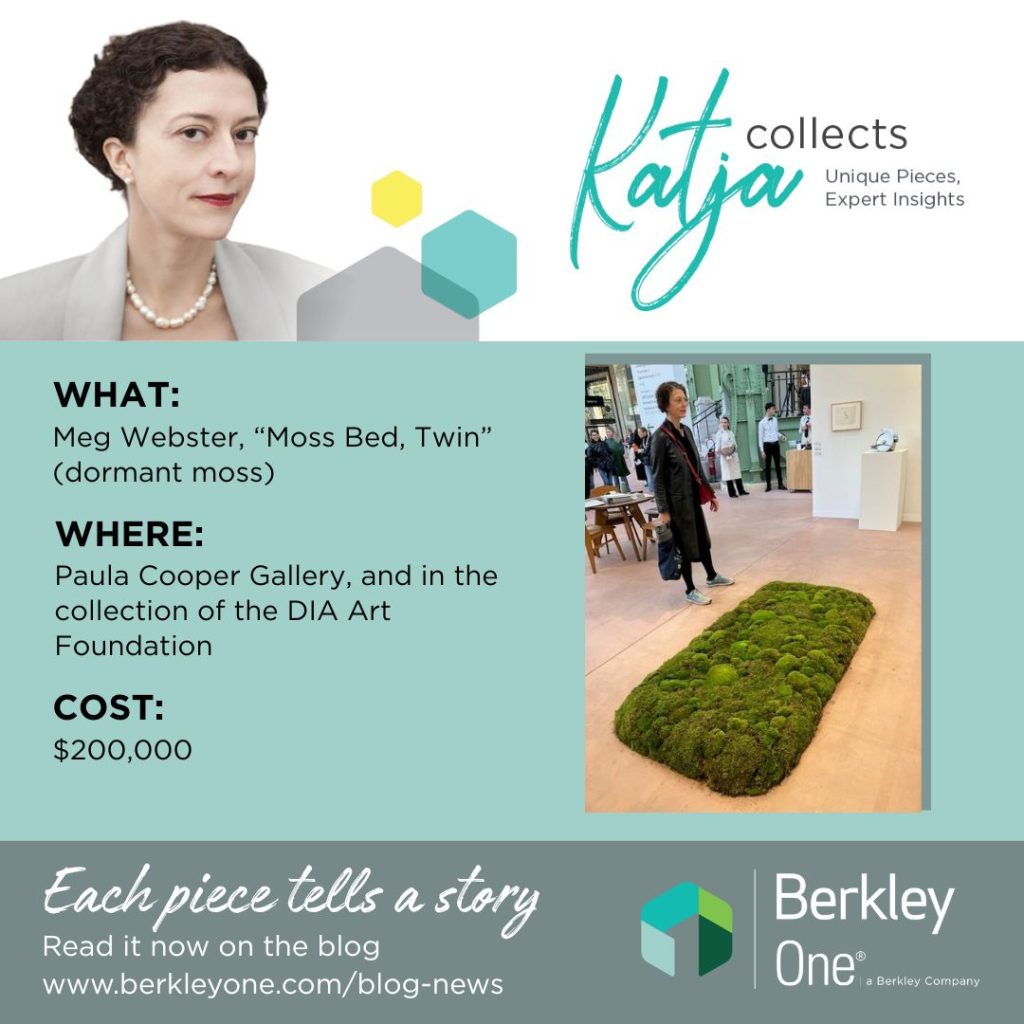
What:
Meg Webster, Moss Bed, Twin (dormant moss)
Where:
Paula Cooper Gallery, and in the collection of the DIA Art Foundation
Price:
$200,000
________________________________________
See It:
Sometimes, an “American in Paris” gets more attention than at home. I propose this to be the case for the American artist Meg Webster (born 1944). Webster is not a household name but is well known as a key practitioner at the intersection of Minimalist and Land art, two movements that were au courant in the 1960s and 70s — and still influence artists today. Interest in Webster spiked this past autumn when visitors to the critically acclaimed exhibit “Minimal” at the Pinault Foundation in Paris were able to view five of her works in the museum’s main rotunda. The five sculptures, conceived between 1988 and 2025, offer a sensory survey of Webster’s practice. The pungent smell of beeswax leads the visitor to an arc-shaped wall made of the golden-hued material. There’s also a low mound of yellow ochre clay in a perfect circle, an eerie half-sphere of red soil that seems to be transported from another planet, a glistening cone of salt crystals reaching skyward, and a circular hedge of mixed foliage1. No surprise then that her New York-based gallerist, Paula Cooper Gallery, displayed an iconic Webster sculpture at Art Basel Paris, one of the highlights of the annual art market calendar that takes place in October every year.
Moss Bed, Twin, is a sculpture comprised of moss plants, in the shape and dimensions of a standard American twin bed. She has created this series in other sizes, like Moss Bed, King, as part of a permanent installation at Dia in Beacon, New York. This is typical of Webster’s artistic practice in which organic materials comprise an ecosystem where color, scent, and sound enter a dialogue with their location.
Webster considers herself an installation artist, and marvels at the impact context has on appreciation of her artwork2. You can lie on a ‘bed of moss’ in nature, and the point is made palpable when viewing the Moss Bed sculpture indoors. In the same way, the round mounds of yellow clay and red earth artworks at the Bourse mimic the spatial perimeter of the building’s rotunda and are perceived differently indoors than similar works displayed outdoors at the Dia Foundation in Beacon, New York. By “containing” natural elements to forms and placing them in an interior location, Webster brings a unique ecological perspective to the formal concerns of Minimalism.
Collect It:
Meg Webster began gathering materials from nature to sculpt into politically and socially evocative shapes during her graduate studies at Yale University. After graduating with her MFA in 1983, Webster moved to New York where she worked as the studio assistant to the Land Artist Michael Heizer and debuted her architectonic sculptures at Donald Judd’s Spring Street studio. By the late 1980’s, Webster was invited to produce large-scale, outdoor earthworks at international institutions.
The land art movement, also known as Earth Art or Earthworks, emerged in the late 1960’s and early 1970’s, and is known for using the natural landscape as both the medium and the site for its creation. American Minimalist art came about at the same time and is typified by artworks composed of simple geometric shapes based on the square and the rectangle. It thereby rejects “abstraction” and affirms the notion that art should have its own reality. Webster works in the liminal space of these two movements, transforming natural material like moss, soil, salt and beeswax into shapes and volumes that can be described as sculptures.
Webster commented on her interpretation of the international movement:
“Minimal is a way to make something so essential and simple, but with material and form … that embraces your experience in a non-contact way. It doesn’t talk to you. It talks to many things and allows you to almost be non-verbal.” 3
The Moss Bed series can be contextualized within her sculptures featuring plants and sustainable ecosystems that she premiered at the 1989 Whitney Biennial. Lifted Wetland (1989)—a steel-lined plywood bed for plants featuring an irrigation system—presaged her larger installations of miniature ecosystems starting in the 1990’s. Public gardens, fountains, and grow-light installations join Webster’s precisely shaped sculptures, organic monochrome paintings, and hydraulic systems in the 2000’s. In 2019, the Dia Art Foundation acquired the artist’s largest body of work. Webster’s work has been included in global museum and gallery exhibitions.
Care For It:
Taking care of art that functions as a miniature ecosystem requires understanding organic materials, stabilizing environmental conditions, minimizing physical disturbance, and conducting regular inspections. The gallery from which you acquire your art is always a good resource for care instructions from the artist. Here are some general considerations:
- Moss requires moderate humidity.
- Mist only if recommended and avoid excessive airflow.
- Use barriers to prevent accidental contact or vibration.
- Perform monthly inspections for pests, moisture issues, and structural slumping.
Berkley One is an insurance provider for modern, sophisticated individuals and families. We’re redefining insurance with technology, innovation, expertise and the backing of Berkley, one of the nation’s premier insurance providers. Offering customized options for homes, automobiles, fine art, collectibles, liability, recreational marine and collector vehicles, we give clients the confidence to move forward and live their adventure.