Windows into a National History
How these four historic homes have shaped America’s story
America’s 250th anniversary serves as an opportune time to reflect on the moments that have comprised our country’s making and the leaders and innovators who helped shape it. So much of this history happened within the home—safe havens for their residents but also, sites of ingenuity and significant political, artistic and engineering contributions. It all informs a larger national narrative, one that continues to be upheld today in how these homes are being preserved—and, in turn, how they are preserving core aspects of America’s identity and origin story. From our first president’s estate to a modern architectural marvel, here are four historic homes to visit now.
A Founding Era Estate:
George Washington’s Mount Vernon
Mount Vernon, Virginia
In 1734, George Washington’s father, Augustine Washington, built a modest one-and-a-half-story house. Washington’s elder half-brother Lawrence inhabited the estate until his death in 1752, and in 1754, George Washington began leasing the home from Lawrence’s widow, Anne Fairfax Washington. Washington inherited the estate in 1761, and he made vast improvements and expansions to the property along the way.
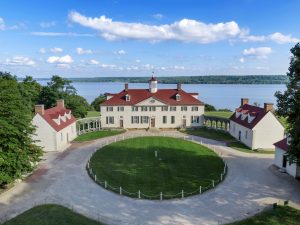
Drone Aerial Photography, 2018
Today, the estate is overseen by the Mount Vernon Ladies’ Association, established in 1853 to preserve the property and its legacy. Before visiting, visitors can purchase a Grounds Pass and reserve a time for a guided Mansion Tour (which includes the New Room, where Washington displayed his collection of artwork). The site offers time to spend exploring the grounds, including four historic gardens, more than a dozen outbuildings, a farm, and the Donald W. Reynolds Museum and Education Center. The estate also hosts ample programming throughout the year, including celebrations for Washington’s birthday and the Fourth of July, fall and spring wine festivals, a 5K or 10-mile Patriot Run, and Christmas illuminations.
A Literature Landmark:
The Mark Twain House
Hartford, Connecticut
Built in 1874, this Hartford, Connecticut home became the site of Mark Twain’s most generative writing years (including where he penned The Adventures of Tom Sawyer and The Adventures of Huckleberry Finn). He and his wife Olivia commissioned New York architect Edward Tuckerman Potter for the property’s construction and design, whose American High Gothic style incorporates Windsor brick, asymmetrical shapes, and multiple balconies.
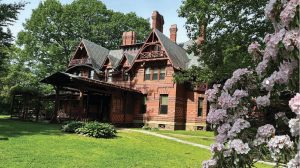
Today, visitors can discover the house with a guided tour (as tours often sell out, it’s best to book tickets in advance). Their calendar lists events and programming, including lectures, author readings, and special themed tours.
An Enclave for Innovation and Industry:
The Edison and Ford Winter Estates
Fort Myers, Florida
After a trip to Fort Myers in 1885, Thomas Edison purchased a 13-acre piece of land that he would soon design into Seminole Lodge, a winter retreat encompassing several houses, a laboratory, and extensive gardens.
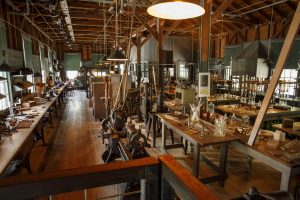
In 1914, Edison’s friend Henry Ford visited Seminole Lodge. The trip prompted the automobile magnate to purchase his own winter property right next door—a Craftsman bungalow estate that would later be called The Mangoes. Edison’s wife Mina deeded Seminole Lodge to the City of Fort Myers before she passed away in 1947, and the estate soon opened to the public.
In 1988, the city purchased The Mangoes, which they opened to the public in 1990. Today, the estates are maintained as a single nonprofit, inviting visitors to come and explore the homes that once served as a site of much discussion and discovery for two of the country’s most innovative minds. Admission includes a self-guided tour of the homes and gardens, or guests can book one of the 60-minute guided tours (for additional time viewing the museum and laboratory, where Edison and Ford tested 17,000 plants in a quest to create a natural domestic rubber). Those interested in automobiles will appreciate the Automotive Tour. Taking place every Monday morning, the special, 90-minute experience is led by an automotive expert and centers on the Edison Ford automobile collection.
An Icon of American Architecture:
Fallingwater
Mill Run, Pennsylvania
Situated in the Laurel Highlands of Southwest Pennsylvania, this architectural landmark and UNESCO World Heritage site evokes the wonder of its natural setting along with its unique place in American history. Designed in 1935 by Frank Lloyd Wright for prominent department store owner Edgar J. Kaufmann and his family, the property stands above a waterfall and features clean, dramatic lines, floating terraces, and expansive glass.
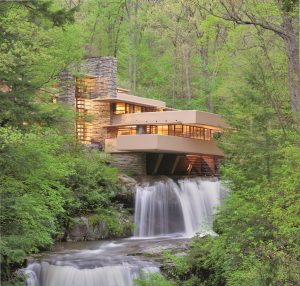
In 1963, Edgar Kaufmann Jr. donated Fallingwater to the Western Pennsylvania Conservancy, a nonprofit conservation organization. Today, visitors can discover Fallingwater throughout the year, touring Wright’s creation and learning about the relationship between Wright and the Kaufmann family. Visitors marvel at the organic details of Wright’s design (including the incorporation of a large boulder rising up through the floor near the fireplace). Tickets are available in advance and availability can be checked online.
_
Berkley One is a Berkley Company.
This story appears in One Adventures, Berkley One’s digital magazine celebrating creators, experiences and stories. Trouble viewing this issue? Don’t forget to use the zoom feature on the bottom toolbar as you read. Read the issue here.
Want even more One Adventures? Read our other issues: Issue 01; Issue 02; Issue 03; Issue 04; Issue 05; Issue 06; Issue 07; Issue 08; Issue 09; Issue 10; Issue 11; Issue 12