Route 66 Turns 100 Years Old
Celebrating the moments, memories, and automobiles of The Main Street of America
This year, coinciding with America’s 250th anniversary is another momentous occasion for our nation: the 100-year anniversary of Route 66. Established on November 11, 1926, the highway created a direct path from Chicago to Los Angeles (later Santa Monica), crossing eight states and spanning 2,448 miles. In the century since, the route has become nearly synonymous with Americana culture, inspiring works by artists like Nat King Cole and John Steinbeck, serving as the setting for a legion of films, and gaining its global “Mother Road” title. But before any of its fame, Route 66 had modest origins.
“This road began as a workhorse,” says William Thomas, Chair of The Route 66 Road Ahead Partnership and Commissioner of the U.S. Route 66 Centennial Commission. “It was specifically designed to connect smaller rural communities to larger commercial markets; it was the path out to prosperity, to leave the Dust Bowl of the Midwest to travel to California for a better life—and it was exceedingly successful at that.”
Now in its centennial, Route 66 continues to soar in popularity for its contributions to American life and culture—a movement Thomas and his team are working to spotlight through their efforts at The Route 66 Road Ahead Partnership and the Route 66 Centennial Commission. “At Road Ahead, we strive to help the millions of people who live, work, and travel along Route 66 by preserving the road—and this centennial year is a great opportunity for us to engage in the projects and events that can help to fuel this mission.”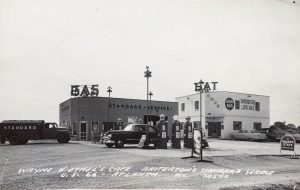
In 100 years and 2,448 miles, Route 66 has many stories to tell. In the 1940s, it was the all-weather pathway that allowed the United States to transport men and material to California’s ports and training bases to fight in WWII’s Pacific Theater. “Without a doubt, Route 66 helped the U.S. to win the war in the Pacific,” says Thomas, who reiterates the road’s vital role in the return journey, too. “These soldiers also all came back home via Route 66, families grew, and all of a sudden, you’re seeing the birth of the Great American Road Trip.”
While trains were the primary mode of transportation for decades, the automobile promised something new: freedom.
“With trains, you needed to follow a schedule—but with the advent of automobiles and all-weather roads, which Route 66 was the first of, suddenly you were completely free to set off on the adventure of your choosing,” says Thomas.
For many, that meant taking the road to its westernmost, California point—and certain car manufacturers were up to the challenge. “General Motors and Ford were very invested in promoting automobiles that could travel the entirety of Route 66, from the Midwest to the West Coast,” says Thomas. “They wanted to prove the worthiness of their creations for such a journey.”
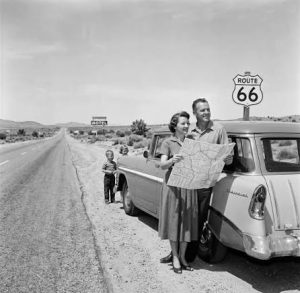
The Ford Model T was the most popular car of the 1920s, comprising nearly half of all automobile sales from 1920 to 1926—followed by its successor, the Ford Model A. In the 1950’s and early 1960’s, in the height of the baby boomer generation and with the advent of the family road trip, the station wagon reigned. The road saw makes and models like the sleek, colorful Chevrolet Nomad, eight-seater Ford Country Squire, and luxury Buick Estate Wagon. The 50’s also brought with it the Chevrolet Corvette (inspiration for Lightning McQueen, lead character in Disney Pixar’s Cars—just one of the movies inspired by the famous road and its integral car history).
The increase in drivers nationwide soon necessitated a faster, wider, and more comprehensive interstate system, which was established in 1956—and in 1985, Route 66 was decommissioned and removed from the U.S. highway system. Several of the towns that the road had served experienced rapid loss of tourism and its accompanying economic support. Restaurants, cafés, and museums closed; one town’s seven filling stations dwindled to a single gas station.
But even without its U.S. highway designation, interest in Route 66 is again on the uptick—a phenomenon Thomas credits to nostalgia and heritage tourism, the act of exploring the traditions and history of one’s origins.
“So many people want to discover their past, and America’s past,” notes Thomas. “This road has been touching every demographic and cultural group of people in this country—I have yet to find a cultural group that doesn’t have Route 66 stories.”
And then, there is the route’s iconic role in American history. “Whether it was the growth of filling stations or the popularization of motels, cafés, and campgrounds, this road has established the infrastructure for much of our daily life as we know it today,” says Thomas. “This is the most famous road in America, if not the world—and we want to continue to honor that.”
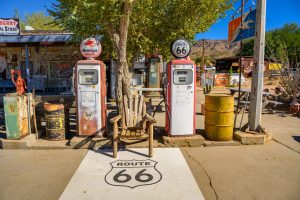
Hackberry, Arizona, USA – November 04, 2023 : Vintage Mobilgas pumps outside Hackberry General Store, a classic stop on historic Route 66 in Arizona.
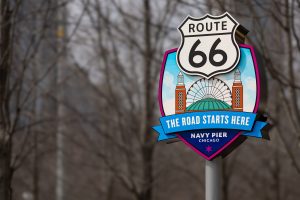
Those who have navigated the route in recent years—which technically begins at the corner of Michigan Avenue and Adams Street in Chicago (symbolically at Navy Pier), and concludes at Olympic Boulevard and Lincoln Boulevard in Santa Monica (symbolically at Santa Monica Pier)—have been supporting the road and the people it serves. Among the countless stops along the Route 66 stretch, some of the most famous include the Blue Whale of Catoosa (a behemoth model built in 1972 by zoologist Hugh S. Davis as a gift for his wife, who loved whales), The American Giants Museum (commemorating a series of Muffler Men, towering roadside advertisement figures crafted in 1960s Venice—not far from Route 66’s Santa Monica terminus), and Delgadillo’s Snow Cap (a roadside stand known for its burgers, milkshakes, and vintage car décor).
For Thomas, there’s one stop, in particular, that holds historic importance: the Threatt Filling Station in Luther, Oklahoma. Built in 1915 by the Threatts, an African American family that had migrated from the South, the site stands as the only African American-owned and -operated filling station along Route 66 during the Jim Crow era. The Threatt family recently worked with The Route 66 Road Ahead Partnership and National Trust for Historic Preservation on a restoration of the site, which also lives on the National Trust for Historic Preservation list of the 11 Most Endangered Places in America.
“The Threatt Filling Station is an irreplaceable historic treasure, and it embodies the significance of telling everybody’s story along the road,” says Thomas.
A renewed dedication in recent decades to preserving Route 66 and its stories has helped to sustain the people and systems on its path. An estimated 110 million Americans plan to travel Route 66 in its centennial year, reflecting a growing desire to discover a road that has been so long intertwined with our nation’s history and culture. Towns along the road’s circuitous alignments have bounced back; restaurants, exhibits, and cafés continue to open. And now, all eyes are turned to the future.
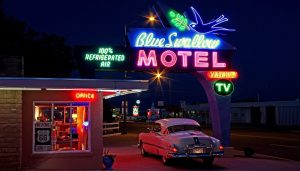
“From the very first day that Route 66 was established, it has been evolving—and now, we’re working to let the road be the impetus for the next infrastructure that will be needed,” says Thomas. Just as Route 66 created an infrastructure for gas-powered automobiles to traverse the nation, Thomas and his team are now focused on how the road can serve as a similar model for alternative energies. Aligned with the highway’s 100th anniversary, The Route 66 Road Ahead Partnership is teaming up with Rivian and their electric R2 SUV for a trip along the Route 66 corridor. “With it, we hope to create an EV guide to Route 66,” notes Thomas.
For Thomas, it’s just one of the ways to carry out the important task of looking ahead for a road that has made such an indelible mark on our nation’s past.
“It is critical, and a lot of fun, to continue to let Route 66 do what it does best: to contribute, in prolific ways, to American history and culture,” he says. “So many of us want to continue to help it, because we know that with it, the future is limitless—this road has proven its power.”
_
Berkley One is a Berkley Company.
This story appears in One Adventures, Berkley One’s digital magazine celebrating creators, experiences and stories. Trouble viewing this issue? Don’t forget to use the zoom feature on the bottom toolbar as you read. Read the issue here.
Want even more One Adventures? Read our other issues: Issue 01; Issue 02; Issue 03; Issue 04; Issue 05; Issue 06; Issue 07; Issue 08; Issue 09; Issue 10; Issue 11; Issue 12