Part 2: Western Art’s Market Momentum and Modern Relevance
Insights from Elizabeth Pisano of Winston Artory Group
Western Art is a genre infused by the past, yet it somehow also remains relevant in the present. In the past decade there has been a surge in property purchased in the western mountain states – think Montana, Wyoming, Idaho, Utah and Colorado. As one generation moves there for retirement, another relishes weekend homes adjacent to ski slopes and open vistas. Recent series like Yellowstone and Landman have underscored interest in the region and its tumultuous social, political, and environmental history. The landscape out West continues to be a source of inspiration to artists today, and contemporary interpretations are on view at galleries, arty fairs, and auction houses from Texas to Arizona, Idaho, and in-between.
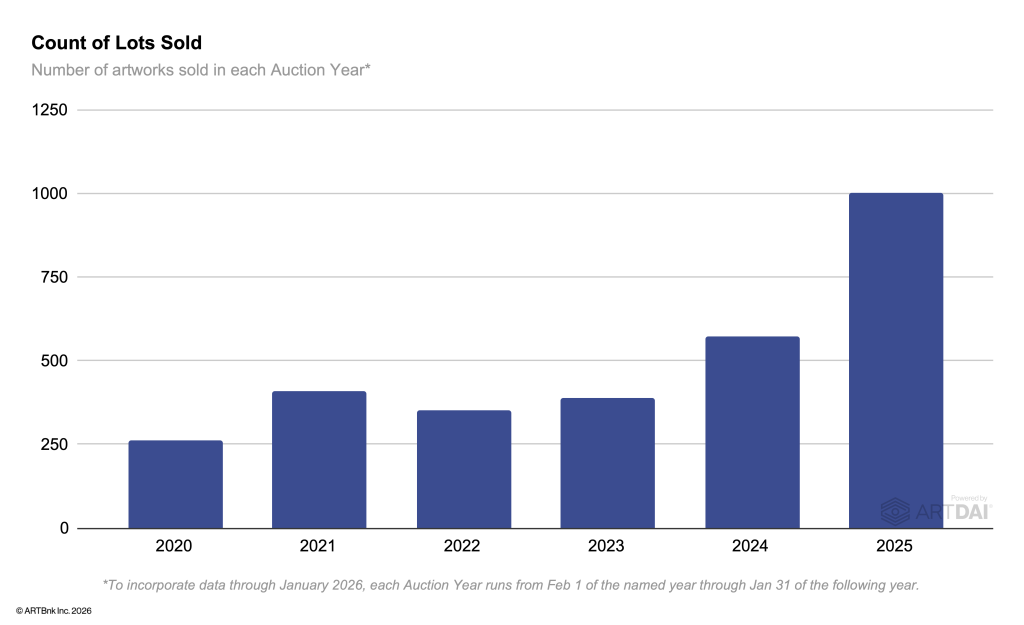
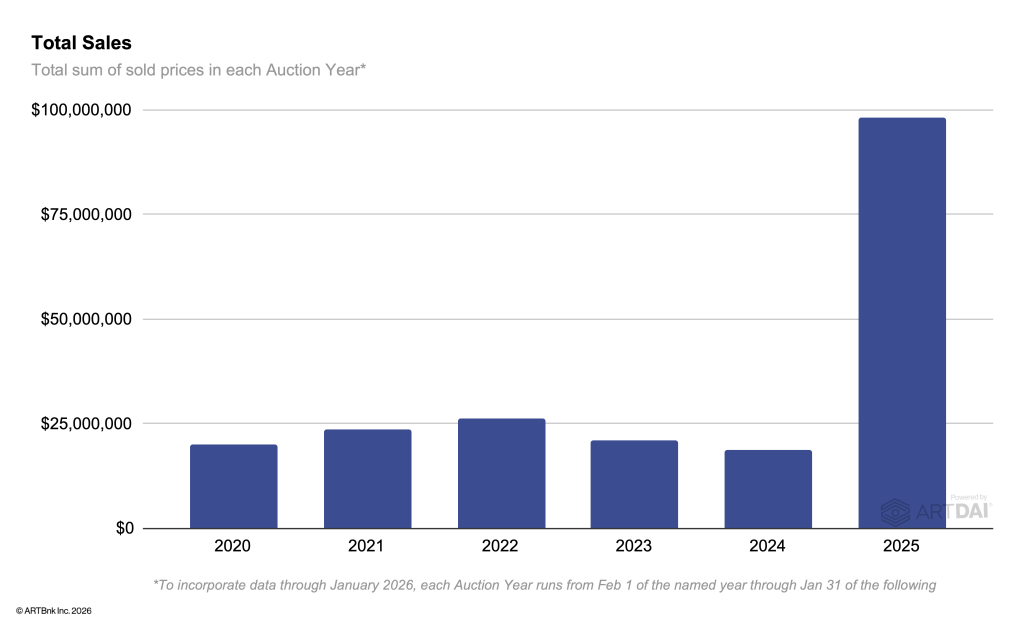
Statistics from ARTdai also underscore the increased market volume and price points in the past year, led by the recent Koch sale at Christie’s.
In the second installment of our Western Art series, we explore the genre’s breadth and recent market resurgence with Elizabeth Pisano, Senior Director and American Art Specialist at Winston Artory Group.
Missed part 1? Read it here
Katja: Most people have an image of the “typical” Western Art collector. It would probably be someone like Mr. Koch. Yet you, Elizabeth, are also passionate about Western Art, I assume you are on the younger end of the age demographic of the typical Western art collector?
Elizabeth Pisano: So, yes. It’s interesting you noted that the collector age is often post-60, because that’s very much a characteristic of the American art category overall, and that’s one of the main obstacles to the traditional category. There was this amazing collector base of people who were lifelong collectors of this type of material, and were so passionate about it, and they’re all just aging out.
We are experiencing a shift in which a generation of established collectors are passing on, and their collecting legacy is coming to the marketplace.
Katja: Another interesting aspect of Western Art is that the genre continues today, and there were a few paintings that sold at auction by living artists. How do artists such as David Mann, Andy Thomas, and Howard Terpning carry on the tradition?
Elizabeth Pisano: I think these artists are definitely indebted to the previous generations working in this genre. The 19th century artists truly created the vision of the American frontier as we know it today: vast, untouched, exciting, and dynamic. Artists like Terpning, Mann, Robert Duncan, ZS Liang, among many others, are building from that tradition. The aesthetic continues to appeal in the current market, increasing so as the West (think Colorado, Wyoming, and Montana) becomes more developed and attracts people from the coasts who are buying second homes or moving permanently. The aesthetic fits right into the context. These locations are aesthetically distinct, and buyers want art that speaks to that context and doesn’t look out of place. The price points for these artists tend to be a bit more accessible than the historic western painters and of course, many of them are still alive and working so quality material is less challenging to come by.
Katja: We’ve been speaking about a unique auction scenario, but there is also a robust gallery and regional scene. Can you provide more color and context about what is happening in the Western Art market throughout the year at galleries and in the region itself?
Elizabeth Pisano: I would also say the regional auction houses are increasingly important players in this market, especially as some of the major global houses are shifting away from their support of the American art category and, folding the property into these more inclusive, expansive sales unless the property comes from a major estate (obviously there are some exceptions here).
The regional houses, like Coeur d’Alene and Scottsdale, and Jackson Hole, among others have really filled a lot of that gap, and they attract collectors who are based in the West already. They really have their finger on the pulse of these buyers whom maybe the eastern New York houses don’t even know about. It’s interesting when you see big commercial galleries like Heather James setting up outposts in Jackson Hole now, and Freeman’s just hired a new head of their Western Art sales, so I think there is a recognition that the demand is there, and the interest is there.
Katja: Speaking of a specific region, Taos, NM also has a western genre art style associated with it…
Elizabeth Pisano: Yes, there was a group of artists, formally known as The Taos Society of Artists, who coalesced around this region beginning in the early years of the 20th century. These artists, who include Joseph Henry Sharp, Eanger Irving Couse, Ernest Blumenschein and Oscar Berninghaus, among others, focused their art on the landscape and native people of this unique region. But of course, beyond the Taos Society the Southwest region has a long tradition of attracting artists and played a critical role in the development of modern art in America as well. Georgia O’Keeffe is probably the most famous example of this.
Katja: Lastly, as an appraiser, do you have any suggestions for clients who collect American and Western Art?
Elizabeth Pisano: It’s the same advice I give to everyone who expresses interest in collecting or even buying a single piece of art:
see as much as you can, read as much as you can. Talk to people who have seen and read things you haven’t. It will make your eye sharper and help clarify your taste. Being a part of this world is a lifelong education; that’s one of the most wonderful things about it!
Books, exhibits, and perhaps even visiting the West are ways to get inspired and informed. The recent market momentum, punctuated by landmark auctions, a revitalized regional gallery scene, and growing interest from younger buyers, suggests not a nostalgic revival but an active, evolving category. Yet Western Art does not occupy a singular place in the story of American art.
The American landscape, and its symbolic meaning for Native Americans and others worldwide, offers diverse perspectives on the country’s complex terrain. This means you’ll find interpretations of the West not just in dedicated auction sales or galleries, but also by Contemporary artists, such as Kay WalkingStick (pictured above). We’ve only scratched the surface of an art tradition that captures both the myth and the reality of the landscape, rooted in history yet continually reinterpreted by new generations of artists and collectors. Western Art continues to resonate aesthetically, emotionally, and culturally, ensuring that the spirit of the West—contested, complex, and compelling—remains firmly part of the contemporary artistic and collecting discourse.
Image credit: Kay Walking Stick, “Sage Brush and Cholla”, 2025, exhibited at Hales Gallery
_
Katja Zigerlig is Vice President of Art, Wine + Collectibles Advisory at Berkley One (a Berkley Company).
Berkley One is an insurance provider for modern, sophisticated individuals and families. We’re redefining insurance with technology, innovation, expertise and the backing of Berkley, one of the nation’s premier insurance providers. Offering customized options for homes, automobiles, fine art, collectibles, liability, recreational marine and collector vehicles, we give clients the confidence to move forward and live their adventure.