Katja Collects: Miles Davis Hand on Trumpet
Unique Pieces, Expert Insights
As the year leans into cooler months, shorter days ask us to savor what endures and dwell on gestures that carry weight. Few images reward that pause like Irving Penn’s 1986 portrait Miles Davis Hand on Trumpet. Beneath the stark silver tones lies not just a musician but the gesture of his hand pressing the instrument as though it were an extension of himself and perhaps his genius. Printed in 1998 as part of a rare edition, this gelatin silver print distills a lifetime of improvisation into a single luminous moment. It reminds us how music and photography can wind wonder into stillness as surely as clockwork once wound motion.
Continue scrolling below the graphic to learn more on this fascinating collectible.
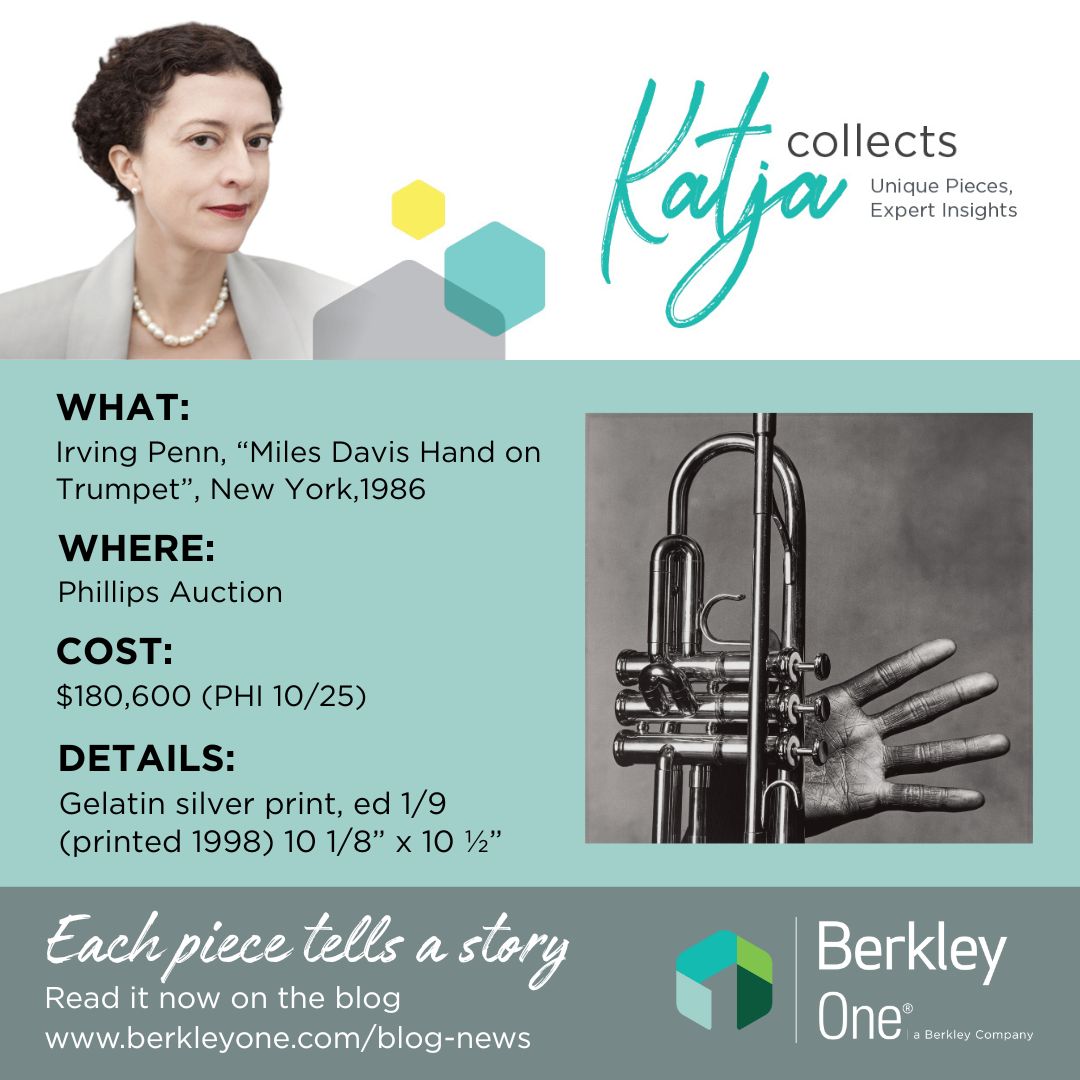
What:
Irving Penn, Miles Davis Hand on Trumpet, New York,1986
Details:
Gelatin silver print, ed 1/9 (printed 1998) 10 1/8” x 10 ½”
Where:
Phillips Auction
Price:
$180,600 (PHI 10/25)
________________________________________
See It:
You’ve likely encountered a photograph by Irving Penn (1917 – 2009) but may not have known its famous originator. From Vogue fashion spreads to gingko leaves and introspective portraits from street cleaners to cultural luminaries, Penn’s legacy is visible in museums and magazines. Although he was best known for his captivating fashion shoots for Vogue, for whom he shot 165 covers between 1943 and 2009, Penn had a prolific career that spanned genres and mediums. Certainly, that high profile commercial work with aesthetic appeal made him a sought-after photographer, and he became one of the 20th century’s most significant photographers and helped establish photography as an independent art form.
In 1986, Irving Penn was hired by Warner Brothers Records to photograph Miles Davis for his new album Tutu. Made under the art direction of Eiko Ishioka, the resulting images, including Miles Davis Hand on Trumpet, remain some of the most indelible photographs of the famed jazz trumpeter and composer. Rather than a traditional facial portrait, Penn captures the essence of the celebrated musician, being his hand as an extension of his instrument.
This photograph exhibits a “stark simplicity” that became Penn’s hallmark.
Emphasizing the essence of his subjects was a revolutionary approach during an era of elaborate artificial lighting and complex backdrops.
Penn’s signature style—employing neutral gray or white backgrounds, natural light (or his self-constructed “light tent”), and careful composition—allowed the subject to speak for itself.
Collect It:
Penn’s photographs are beloved by collectors and museums for both their technical and aesthetic polish. Beyond the image itself (be it of fruit, fashion or a jazz musician) lies the critical aspect of the print. Most of Penn’s portrait photographs, such as Miles Davis Hand on Trumpet, were produced using the gelatin silver print method. However, he also mastered a range of printing techniques, including the labor‑intensive early processes of platinum and palladium printing, which afforded exceptional control over tonal variation. A collector of photography should understand the differences between a vintage print (made close to the time the photograph was taken), a later print (often a more common gelatin silver or dye-transfer print), and estate prints, as these distinctions dramatically affect value and historical significance.
Because Penn personally oversaw and experimented with his prints, the print date does not necessarily influence value in the same way it does for some other artists. For instance, the Miles Davis photograph was taken in 1986 but printed in 1988, which was still during Penn’s lifetime, as he passed away in 2009.
Collectors should seek prints with well‑documented provenance, since ownership history can significantly enhance both value and authenticity.
Notably, the photograph Miles Davis Hand on Trumpet was among 70 lots sold by the Irving Penn Foundation at Phillips auction house in New York in September 2025.
Artwork that comes directly from an estate has excellent provenance, and has likely been preserved in the best condition, making these works more desirable for collectors. This was certainly the case with the Irving Penn photographs sold at this auction, as the sale achieved $4.9 million against an estimate of $3.1 million, with 94 percent of lots finding buyers1. The appeal of acquiring a photograph by Penn resides in the enduring power of his images, their formal perfection, and the pride in owning a work by one of the 20th century’s greatest visual artists.
Care For It:
A photograph needs to be protected from light, temperature, and humidity fluctuations to prevent fading and damage. Specifically, a relatively dry (30-50% relative humidity (RH), cool (70°F or below), and stable environment is best. Avoid storage in attics and basements.
When considering where to display your photographs, avoid proximity to vents, fireplaces and radiators. Ideally also refrain from hanging photographs along exterior walls; or other locations with high risk for condensation, water leaks, and extreme environmental fluctuations2.
Get your photograph framed by a professional using archival materials as well. For more resources on the care, handling and storage of photographs, check out resources suggested by the Library of Congress.
Berkley One is an insurance provider for modern, sophisticated individuals and families. We’re redefining insurance with technology, innovation, expertise and the backing of Berkley, one of the nation’s premier insurance providers. Offering customized options for homes, automobiles, fine art, collectibles, liability, recreational marine and collector vehicles, we give clients the confidence to move forward and live their adventure.